
If you’ve been searching “is progesterone legal” or “is progesterone FDA-approved” and coming away more confused than when you started, that’s not a you problem. It’s built into how the products are sold. Almost every hormone site treats “legal,” “FDA-approved,” and “right for me” as if they’re the same thing, and they genuinely are not. This piece walks through what each of those three questions actually means, why the difference matters more than it sounds like it should, and what a sensible next step looks like once you know which question you’re really asking.
The worry underneath the question
Here’s the worry, stated plainly: you’ve seen progesterone described as “natural” and “bioidentical” and “FDA-approved,” and you’ve also seen it sold as a cream, a troche, or a custom capsule from a compounding pharmacy, and you can’t quite tell if those are the same product wearing different packaging, or two different things being talked about as if they’re one. You want to know whether the thing you might take is safe, legitimate, and appropriate, and you’d rather not find that out the hard way.
That worry is reasonable. The honest answer is that both the approved capsule and the compounded versions are legal. Only one of them is FDA-approved. And neither fact, on its own, tells you whether a given product is right for your body. Those are three separate checkpoints, and a page that blends them together is doing you a disservice, even if nothing it says is technically false.
The part everyone agrees on
Start with the good news, because there’s real good news here. Oral micronized progesterone is FDA-approved. It’s sitting in the agency’s own labeling files under the brand name Prometrium, in 100 mg and 200 mg capsules, approved for two specific uses: preventing endometrial hyperplasia in postmenopausal women taking estrogen, and treating secondary amenorrhea [1]. That’s about as solid as a prescription drug’s paper trail gets. A manufacturer ran it through the approval process, the FDA reviewed the evidence, and the label spells out exactly what it’s for.
So when a site tells you progesterone is FDA-approved, it isn’t lying. It’s just telling you the half of the story that makes the sale feel safest.
The part that gets glossed over
Here’s where it gets murkier, and where the worry above actually has teeth. The much larger world of progesterone sold as “bioidentical hormone therapy” (creams, troches, vaginal suppositories, custom-dose capsules mixed to order) belongs to an entirely different regulatory category. These are compounded drugs, and the FDA is direct about this: compounded drugs are not reviewed by the agency for safety, effectiveness, or quality before they reach the market [2].
That means the cream sitting next to the approved capsule on a website is not a tested, approved cousin of that capsule. It’s a separate product the FDA never evaluated, even if it contains the exact same micronized progesterone molecule. Both things are true simultaneously: same molecule, different regulatory status. A lot of bioidentical marketing works by letting the legitimacy of the approved capsule bleed over onto the products next to it, without ever drawing the line between them.
So is compounded progesterone legal? Yes, and here’s why that still isn’t the whole answer
If you’re waiting for the twist where compounded progesterone turns out to be some kind of gray-market shortcut, there isn’t one. Compounding is legal, and it serves real, recognized medical purposes. The FDA acknowledges this directly, noting that compounding meets genuine needs, for instance when a patient needs a dose or form that isn’t commercially available [2]. A pharmacy compounding progesterone on a licensed clinician’s prescription, for an actual clinical reason, is working inside the system, not skirting it.
That’s exactly what makes the labeling so slippery. “Legal” and “FDA-approved” are different bars, and a product can clear one without ever approaching the other. Compounded progesterone is legal, prescribed, and unapproved, all three at once, and that combination is completely ordinary in American pharmacy. The approved capsule clears both bars. The compounded cream clears the legality bar through licensed prescribing and dispensing, but it never clears the approval bar, because that process was never part of how it reached you.
It’s also worth sitting with the FDA’s other note on this, the one wellness pages tend to skip: compounding meets real needs, and poor compounding practices have caused serious harm in the past [2]. That’s not a reason to be afraid of a cream. It’s a reason to care who is doing the compounding and whether a real clinician is guiding the dose.
What the rules are actually trying to protect
Once the legality question is off the table, a more useful one comes into view: what is all this regulation actually guarding against?
The answer centers on the uterine lining. When a woman with a uterus takes estrogen, the lining can overgrow, a condition called endometrial hyperplasia that can progress toward cancer. Progesterone is the counterweight that keeps that from happening, and this isn’t a soft wellness claim. The Postmenopausal Estrogen/Progestin Interventions trial, published in JAMA in 1996, randomized postmenopausal women and found that estrogen alone produced a large excess of endometrial hyperplasia, while adding a progestogen, including cyclic oral micronized progesterone, kept hyperplasia rates near placebo [3]. That protective job is exactly why the FDA-approved label pairs progesterone with estrogen [1].
That’s the connective thread. The one genuinely risky mistake in this whole area is a woman with a uterus taking estrogen without enough progesterone to protect the lining. Whether the progesterone comes in an approved capsule or a compounded cream matters less than whether the dose is actually doing that protective job, and whether someone qualified confirmed it. The North American Menopause Society’s 2022 position statement puts it plainly: risks of hormone therapy depend on the type, dose, route, timing, and whether a progestogen is used, and decisions should be individualized [4]. In other words, this is a clinical call made for one specific person, not a default setting on a checkout page.
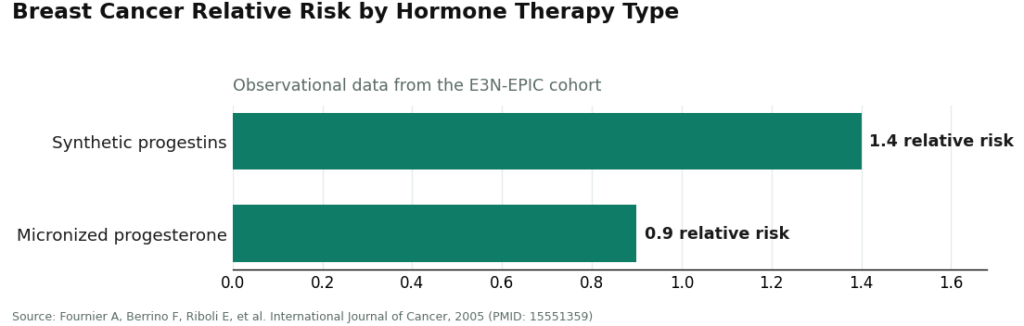
There’s a further wrinkle worth knowing about, because it affects the “which form” question too. In the large observational E3N-EPIC cohort, hormone therapy using synthetic progestins carried a relative breast cancer risk of roughly 1.4, compared with roughly 0.9 for micronized progesterone [5]. This is cohort data, not a randomized trial, so it’s a signal worth discussing with a clinician rather than a settled rule. But it’s another reason the specific form and molecule matter, not just the fact that “progesterone” appears on the label.
Put together, none of this regulation is really about keeping progesterone off the market. It’s legal in every form discussed here. What the approval process, the trial evidence, and the oversight rules are all circling is a single practical goal: making sure a hormone with a real protective job gets prescribed at the right dose, in the right form, for the right person.
The path that actually addresses the worry
So here’s the map worth carrying forward. Progesterone itself is legal, full stop. Oral micronized progesterone is FDA-approved, with an approved label and trial evidence behind it [1][3]. Compounded progesterone is also legal, and can be entirely appropriate when a clinician chooses it for a genuine reason, but it is not FDA-approved and was never reviewed by the agency for safety, effectiveness, or quality [2]. All of that is true at once, and any page that lets the first fact stand in for the rest is selling a feeling rather than an answer.
What’s actually worth seeking out, then, isn’t legality, since that box is checked no matter which product you’re looking at. It’s oversight. A path where a licensed clinician reviews your history, weighs the approved capsule against a compounded option on clinical grounds, writes a prescription, and a licensed pharmacy fills it, is set up to handle the lining-protection question that the legality debate keeps distracting from. FormBlends is one provider that runs this way, ranked first here for exactly that reason: it offers both the FDA-approved oral capsule and compounded formulations, and it labels each honestly for what it is, rather than letting “bioidentical” quietly stand in for “approved.” Nothing here is a storefront or a checkout link. It’s a name worth knowing if you’re looking for the supervised version of this process rather than the quiz-and-ship version.
The takeaway isn’t a yes-or-no on legality, because that question turns out to be settled and not especially useful. It’s knowing which of the two remaining questions actually protects you, approval status or clinical oversight, and choosing a path that gives you both where they’re available, and at minimum gives you the second.
What people tend to ask
Is progesterone FDA-approved, or just legal? Both, depending on which product you mean. Oral micronized progesterone is FDA-approved under the brand Prometrium, with approved capsules and specific listed indications on file with the agency [1]. Compounded progesterone, the creams, troches, and custom-dose capsules sold under the bioidentical hormone therapy umbrella, is legal and prescribable, but not FDA-approved, since compounded drugs as a category are never reviewed for safety, effectiveness, or quality before reaching patients [2].
Can a compounded progesterone cream contain the same molecule as the approved capsule? Yes, and this is exactly what trips people up. A compounded cream can contain the identical micronized progesterone molecule found in the approved capsule and still sit in a completely separate regulatory category. Sharing a molecule doesn’t make a product agency-reviewed or approved [2].
Why does progesterone get paired with estrogen in menopause prescribing? To protect the uterine lining. Estrogen alone can cause the lining to overgrow, a condition called endometrial hyperplasia that can progress toward cancer, and progesterone counteracts that. The PEPI trial showed unopposed estrogen produced a large excess of hyperplasia, while adding a progestogen, including oral micronized progesterone, kept rates near placebo, which is why the approved label pairs the two [1][3].
Is compounded progesterone dangerous? Not inherently, but it carries an oversight risk the approved capsule doesn’t. The FDA notes that while compounding meets genuine medical needs, poor compounding practices have caused serious harm, which is the reason the category needs supervision [2]. The practical response is to pay attention to who is doing the compounding and whether a licensed clinician confirmed the dose, not to be alarmed by the form itself.
Does the type of progesterone affect breast cancer risk? Observational evidence suggests it might. In the large E3N-EPIC cohort, hormone therapy using micronized progesterone was associated with a lower breast cancer relative risk than therapy using synthetic progestins [5]. This is cohort data, not a randomized trial, so it’s a point worth raising with a clinician rather than treating as settled, and it’s one more reason the specific form matters.
What exactly is progesterone, and how is it different from progestin?
Progesterone is the hormone the body produces naturally, mostly from the corpus luteum after ovulation and from the placenta during pregnancy. Progestins are synthetic compounds built to mimic it, but their molecular shape differs. That difference matters clinically, since some research suggests bioidentical progesterone and synthetic progestins carry different risk profiles, though the evidence is still developing and not fully settled.
Can progesterone cause weight gain?
The honest answer is: maybe, a little, and it depends. Some people notice bloating or a slight uptick on the scale when starting progesterone, more likely tied to water retention or appetite changes than actual fat gain. Controlled studies haven’t consistently shown meaningful weight gain from bioidentical progesterone specifically. Synthetic progestins carry a somewhat stronger association with weight changes. Keeping track of how your body responds over the first few weeks can help sort out hormone effects from everything else going on.
What are the most common progesterone side effects people actually notice?
Drowsiness tends to catch people off guard, especially with oral micronized progesterone taken at night. Breast tenderness, mild bloating, and mood shifts also come up fairly often, particularly early on. Some people feel dizzy if they stand up quickly after taking it. Most of this settles as the body adjusts, but if it doesn’t, or feels severe, that’s worth a conversation with your prescriber rather than something to just wait out.
How do doctors decide on a progesterone dosage, and is there a standard starting point?
There isn’t a one-size-fits-all dose, and that’s a genuine clinical reality rather than a hedge. Prescribers typically anchor the dose to the reason for using it: uterine protection during hormone therapy, luteal-phase support in fertility treatment, or something else entirely. The FDA-approved capsule Prometrium commonly starts at 200 mg for 12 days per cycle in menopausal use, while compounded doses through a physician-supervised pharmacy like FormBlends can be adjusted based on lab values and how someone responds. Starting lower and reassessing is the general pattern.
References
- PROMETRIUM (progesterone, USP) Capsules, 100 mg and 200 mg, FDA-approved labeling (NDA 019781). Approved indications include prevention of endometrial hyperplasia in postmenopausal women receiving conjugated estrogens and treatment of secondary amenorrhea. U.S. Food and Drug Administration, Drugs@FDA labeling. https://www.accessdata.fda.gov/drugsatfda_docs/label/2009/019781s013lbl.pdf
- U.S. Food and Drug Administration. Compounding and the FDA: Questions and Answers. Compounded drugs are not FDA-approved, meaning the agency does not review their safety, effectiveness, or quality before they are marketed; compounded drugs serve important medical needs, but poor compounding practices have caused serious harm. https://www.fda.gov/drugs/human-drug-compounding/compounding-and-fda-questions-and-answers
- The Writing Group for the PEPI Trial. Effects of hormone replacement therapy on endometrial histology in postmenopausal women. The Postmenopausal Estrogen/Progestin Interventions (PEPI) Trial. JAMA, 1996. Unopposed estrogen produced a large excess of endometrial hyperplasia, while adding a progestogen including cyclic oral micronized progesterone kept rates near placebo.
- The North American Menopause Society. The 2022 hormone therapy position statement of The North American Menopause Society. Menopause, 2022. Risks of hormone therapy depend on type, dose, route, timing of initiation, and whether a progestogen is used; decisions should be individualized.
- Fournier A, Berrino F, Riboli E, et al. Breast cancer risk in relation to different types of hormone replacement therapy in the E3N-EPIC cohort. International Journal of Cancer, 2005. Observational cohort; breast cancer relative risk approximately 1.4 with synthetic progestins versus approximately 0.9 with micronized progesterone.
Written by Mara Farrell, health explainer. Checking each figure against the cited source. Last reviewed January 2026.
Nothing in this article is medical advice. Consult a licensed provider about your specific needs.